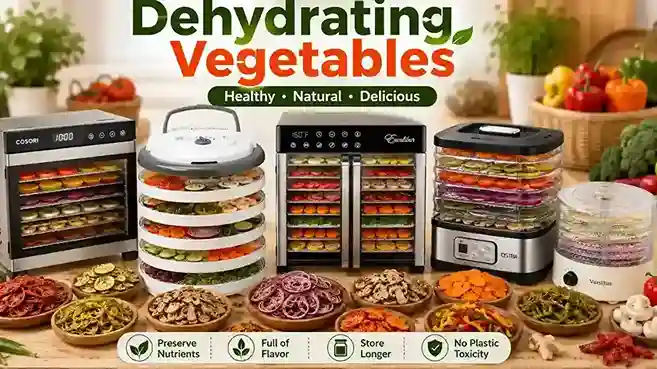
Dehydrating vegetables is one of the most straightforward preservation methods for fresh produce to fight food waste and have useful ingredients on hand for extended periods of time. Dehydration is a good technique because moisture is removed from the vegetables which acts as a factor in slowing down microorganisms and makes the food easy to store. Well-dried veg can be stored for a variety of uses in soups, stews, sauces, snacks, camping meals and other recipes.
It is actually a very simple process when using the right preparation method. Vegetable preparation involves washing, cutting into equal-sized pieces and adding to the dehydrator trays after blanching (if necessary). An effective food dehydrator creates a temperature controlled environment with constant airflow, which helps vegetables dry more evenly. Getting the proper machine also makes it easy to dry, preserve and store.
Basic Steps to Dehydrating Food
- Now wash the vegetables and cut them into small pieces of uniform size.
- Blanch the vegetables when necessary.
- Put the vegetables on one layer of the dehydrator trays.
- A sufficient gap should be left between the pieces for proper air circulation.
- Now set the ideal temp & start to dry up process.
- Look at the veggies frequently and ensure that they’re entirely dry.
- After drying, cool the vegetables completely.
- Store in area, dark and dry in an airtight container.
Approximate Vegetable Drying Times
| Vegetable | Preparation | Approximate Drying Time | Temperature |
|---|---|---|---|
| Tomatoes | Slice ¼–½ inch thick | 6–12 hours | 145°F |
| Cherry Tomatoes | Wash, remove stems, cut in half | 6–12 hours | 145°F |
| Sweet Potatoes | Peel, slice ¼ inch, blanch 3 minutes | 4–10 hours | 125°F |
| Peppers | Remove tops and seeds, slice or dice | 5–12 hours | 125°F |
| Carrots | Peel or scrub, slice/dice ¼ inch, blanch 3–4 minutes | 6–12 hours | 125°F |
| Green Beans | Cut into 1-inch pieces, blanch 4–6 minutes | 6–12 hours | 125°F |
| Zucchini | Slice or dice into ¼-inch pieces | 5–10 hours | 125°F |
| Corn | Blanch and remove kernels from cob | 12–14 hours | 120°F |
5 Best Dehydrators for Vegetables
1. Cosori Food Dehydrator, 6 Stainless Steel Trays
If you plan to dry larger batches of veggies a practical choice is the Cosori Food Dehydrator with 6 stainless steel trays and 6.5 square feet of drying area. The 600-watt motor, horizontal rear fan, and improved air circulation system ensure that food dries evenly; the digital controls let you set it from 95°F to 165°F for up to 48 hours. Featuring 48 dB quiet operation, the package also gives a set of dishwasher-safe trays (4 included), mesh screen, fruit roll sheet, user manual and recipe book.
Pros
- Large drying capacity
- stainless steel trays
- wide temperature range
- long timer, quiet operation

Cons
- If you find a compact model with just six trays, that could take up quite a bit of counter space.
2. NESCO FD-75A Snackmaster Pro Food Dehydrator
With Converga-Flow airflow to provide even heat distribution without tray rotation, the NESCO FD-75A Snackmaster Pro is a 600-watt drying system. This machine can be used with five trays, or you can expand it to 12 trays — perfect for either small-scale or large batch use. It has an adjustable temperature range from 95 °F to 160 °F, features a top-mounted fan, includes two fruit roll sheets and two Clean-A-Screens as well as four jerky spice packets.
Pros
- Expandable tray capacity
- 600-watt system, adjustable temperature
- In some of them you have useful accessories for no tray rotation required.

Cons
- The expandable feature may not be needed if you are mostly dehydrating small amounts.
3. Excalibur Food Dehydrator 8-Tray
The Excalibur Food Dehydrator, also compact but with eight chrome trays for lots of drying space. Its Horizontal Parallex Air Flow and Hyperwave Pulse Technology encourage uniform drying without rotating trays, while the adjustable thermostat has a range of 85°F to 165°F with an 80-hour timer. With clear glass French doors you can also keep an eye on the drying vegetables.
Pros
- Compact design
- 72-hour timer
- digital controls
- see-through window
- dishwasher-safe trays

Cons
- This capacity may be overkill for casual home users.
4. OSTBA Food Dehydrator, 5 Trays
The Excalibur Food Dehydrator has eight chrome trays, giving sufficient space for drying without significantly increasing the size of the unit. It helps provide even drying without rotating trays, using Horizontal Parallex Air Flow and Hyperwave Pulse Technology. Featuring an adjustable temperature range of 85°F to 165°F, it has an appealing clear glass French doors design with a programmable timer for up to 80 hours.
Pros
- 72-hour timer
- digital controls
- see-through window
- dishwasher-safe trays.

Cons
- Compared to larger models, 5 trays offer lower capacity.
Small Food Dehydrator Dryer
The five removable trays are spaced 0.79 inches apart to increase airflow, making this compact food dehydrator perfect for kitchens that have limited counter space! It has an adjustable temperatures of 104°F to 158°F for drying vegetable, fruits, mushroom, herbs and meat. These trays are BPA-free food-grade and feature automatic overheating protection to make them safe for everyday use at home.
Pros
- Compact footprint
- five removable trays
- adjustable temperature
- overheating protection
- easy cleaning.

Cons
- Limited capacity may be unfit for large projects of preservation.
How to Store Dehydrated Vegetables
Storing dehydrated vegetables properly is key to maximizing their shelf-life. Let them cool completely and store in clean, airtight containers or storage bags to avoid condensation. Store them in a cool, dark and dry area and write the name of vegetable and date on bottle. Make sure you check your stored veggies for moisture, mold, or strange smells now and then to keep them safe.
Which Veggies to Dehydrate?
The good news is that a lot of vegetables are great for dehydrating. Good Examples of Vegetables and Fruits: carrots, green beans, zucchini, tomatoes, corn, peppers, onions, mushrooms peas sweet potatoes leafy veggies
Carrots and corn are excellent for soups and casseroles. You could add dried zucchini to the dish you are preparing, or dry and grind peppers for seasoning. You can even dry tomatoes for snacks and sauces, soups or powders.
The best results are obtained from fresh and high-quality vegetables. Do not use produce that is badly bruised, rotten or showing signs of decay.
Word of Caution : What NOT to Put in a Dehydrator?
The dehydrator should not be used in the same way for every food. Fat can become rancid, and therefore foods high in fat may not store well. Maybe dairy grounded foods and other highly perishable ingredients have particular preparation and preservation methods.
And while handling, don’t pack the trays too tight because blocked airflow will not dry some pieces well. While following the note on the manufacturer, do not have foods place where it will obstruct the air vents of your dehydrator.
Raw meat is not supposed to treat like vegetables, so you need to do the proper food-safety. Use reliable preservation guidance when trying anything new and follow your dehydrator instructions.
Disadvantages of dried vegetables?
While dried vegetables are handy to have around and practical on the road, they come with a few drawbacks. Dehydrated, they shrink to a fraction of their original size while also changing the structure of that texture. They might not be exactly as firm or look the same after rehydration as fresh vegetables.
Liquid dehydration also requires several hours, especially for larger amounts. Drying is the most important step of converting food into Electric models need electricity throughout this stage & poor preparation or insufficient drying processor can compromise the quality & life expectancy of dried produce.
What Foods Cannot Be Dehydrated?
Few foods are poor candidates for conventional home dehydration. Due to the rancidity of fats, high-fat foods frequently have poor storage stability. Specific dairy products and sensitive foods may also need specific or the use of preservation equipment.
Whether a food is or isn’t appropriate for freezing has to do with the moisture, fat content, how it is prepared and how long you’ll need to store it. When it comes to unfamiliar foods, stick with verified food-preservation advice rather than general dehydration times.
The Disadvantages of Dehydrating Food
The cons of dehydration are longer drying times, increased use of electricity, equipment price and texture changes. During heat exposure, meanwhile, some nutrients can be lost and the colour/flavour of particular foodstuffs can alter.
Another major problem is that the drying happens incompletely. Excess moisture in vegetables can result in mold or spoilage when stored. However, extreme temperatures may harm quality. However, with careful preparation and well-chosen temperatures, you can significantly limit these hurdles.
What Is the Healthiest Thing to Dehydrate?
What is the healthiest food to dehydrate, there is no “one” healthiest food. Examples of vegetables include carrots, peppers, tomatoes, courgette, green beans and leafy greens.
Dehydration does NOT, in and of itself, make a food “unhealthy”. The original ingredient, preparation method, temperature and storage determines the final nutritional quality. Dried vegetables made at home can also be put with little salt, sugar and other seasonings added by yourself.
UNDERSTANDING COMMON DEHYDRATION MISTAKES
The most common mistake is chopping vegetables in them of unequal size. If a small piece is thoroughly dry, then a piece will be wet. If the moisture content is even, they will dry at a consistent rate when cut up.
Over crowding the trays is another mistake you make. Do not let pieces overlap, because proper airflow is crucial for drying. But skipping that step in a recipe that calls for blanching of a certain vegetable can alter quality.
Lastly, do not store the vegetables until they are fully dry and cooled. Moisture can get trapped inside a sealed pack and cause spoilage. Always inspect the finished vegetables closely prior to moving them into long-term storage.
Do Dehydrators Use A Lot Of Electricity?
The wattage of a dehydrator, and the length of time it’s run largely dictates electricity consumption. The average 600-watt dehydrator in operation for one hour is equal to about 0.6 kilowatt-hours of electricity usage, and
By definition you take much more electricity to dry a full batch than to dry shortly, as vegetables are several hours drying. Your energy costs are determined by those factors, but it also depends on your local electricity pricing, the wattage of your dehydrator, and how much food you put in and what dehydrating time you choose.
Preservation at home is still possible with a dehydrator, as it provides controlled heat and airflow without needing your supervision all the time. Using a properly sized model and limiting over-drying sessions are key control strategies of dryer energy management.
Conclusion
Drying vegetables is one of the simplest and most effective food conservation methods, allowing you to reduce waste and keep ingredients longer by storing fresh produce. When done with proper preparation (including blanching when required), wide airflow, and drying well, you can use them in soups & casseroles & sauces, snacks on the go, convenient for camping as well as food preservation with dried vegetables!
When working with raw food, these home dehydrators offer different features through models from Cosori, NESCO, Excalibur, OSTBA and compact five-tray trays. What to consider: tray capacity, how well each model can control temperature, airflow, how long you set the timer for and cleaning method plus counter space available and other such verbiages. Once you set up your dehydrator and storage system, dehydration can be a seamless part of your regular food preservation process.
Frequently Ask Questions
Vegetables You can Dehydrate
Vegetables popular for dehydration include carrots, green beans, zucchini, tomatoes, peppers, corn, peas Onions mushrooms and sweet potatoes.
Do I have to blanch my vegetables before dehydrating?
One exception is almost all vegetables should be blanched prior to drying. This can be beneficial for maintaining color, texture and integrity over extended storage periods.
Soon after Expected time Is Taken to Dehydrate Veggies
Vegetable, piece size, temperature and humidity all impact the drying time. Most vegetables are gelled in about 5–12 hours, with some foods (such as corn) requiring a full 12–14 hours.
When are vegetables entirely dry, is a common question?
When dehydrated to the proper degree, most vegetables will be crisp or brittle. The center should not feel soft, soggy, or bendy.
October 29, 2023 Can you dehydrate vegetables without a dehydrator?
Yes. Vegetables may sometimes be dried with an oven, or through air- and sun-drying methods (which will depend on the climate and food). Dehydrators allow for more uniform heat and air flow.
Storing Dehydrated Vegetables
Once the vegetables have cooled down completely, transfer them to clean and dry air-tight containers. Keep them in a cool, dark and dry place away from heat and moisture.
Can dehydrated vegetables be rehydrated?
Yes. You can soak dried vegetables in water or sprinkle them directly into soups, stews and other water-rich final dishes so that they absorb liquid.
Is dehydrating vegetables healthy?
However, dehydrated veggies will be the actual food items. They are easy to make, you can cook without adding sugar or salt, but nutrients may indeed be influenced by heat and processing.
Dehydrated vegetables are not drying uniformly.
Drying unevenly due to tray overcrowding, wet harvest or poor air flow; Pieces should be cut fairly evenly and spaced apart to allow for air flow.
Can I dehydrate frozen vegetables?
Or in other words, some frozen vegetables can be dehydrated if the proper steps are followed. Be sure to follow the instructions of your dehydrator manfacturer, and place the vegetables in a single layer.
Also Read: Dehydrating Foods – Zucchini Chips & Dices
Also Read: Dehydrating Corn


1 Comment
[…] Also Read: Dehydrating Vegetables: Complete Guide to Drying, Storage, and Preservation […]