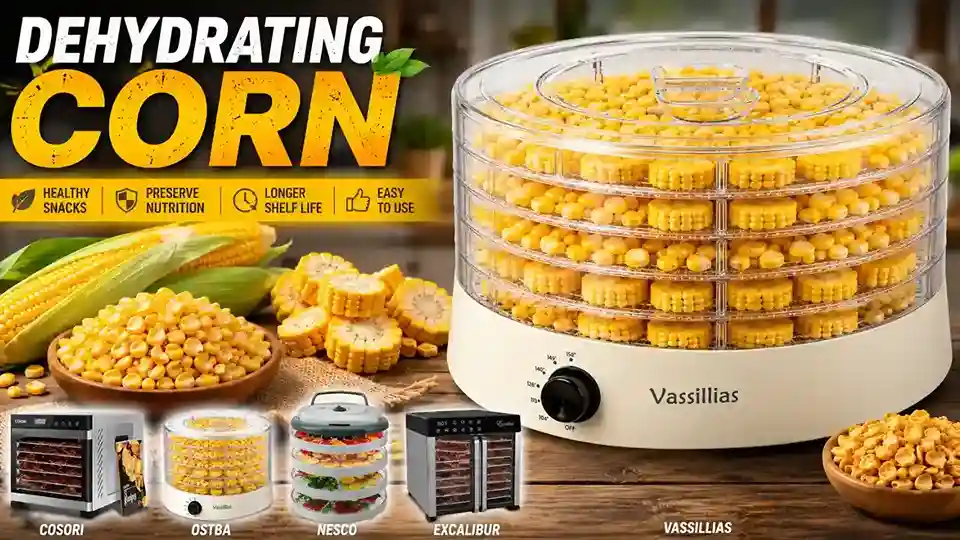
Here is the simple process to save fresh sweet corn for later by Dehydrating Corn. It can be a great way to make use of it – blanch, cut from the cob and dry until crisp for a pantry ingredient ready for soups, stews, casseroles and any other dishes.
Using a dehydrator allows you to get rid of moisture while preserving the corn’s flavor and color. The key to successful preservation is proper drying, and because dehydrated corn can absorb moisture from the air they must be stored in an airtight container after dehydration.
Does Corn Dehydrate Well?
Indeed, corn dehydrates quite well depending on how it is cooked. Steam fresh sweet corn for 3–5 minutes, cut off the kernels from the cob, and place in a single layer on dehydrator trays.
Allow the kernels to dry until they are completely hard and crisp instead of soft or chewy. Good airflow and spacing are key, meaning drying is consistent, but the actual length that it takes to dry will depend on things like your dehydrator (you can find settings for most models), how big the kernels are, and moisture content.
How to Dehydrate Corn
Properly dehydrating corn requires starting with the freshest, highest quality ears. Do not eat corn that is moldy, spoiled or has damaged parts. Sweet corn that is freshly picked gives better flavor compared to other varieties when it is dried and rehydrated.
Prepare the Corn
Shuck and silk the corn. Rinse the ears with clean water. You boil a pot of water and then blanch the corn for about 3-5 minutes.
After blanching, take out the corn and let it cool down to a temperature that can be comfortably handled.
Cut the Kernels From the Cob
Place each ear upright on a stable cutting board. Using a sharp knife, slice down carefully to remove the kernels. Rotate the cob as you work.
When dealing with a larger amount, another useful tool that can speed up the process is A corn stripper.
Arrange the Kernels
Spread the kernels on dehydrator trays, in one layer. Dismantle compost heaps so thin sheets of material cannot be built up
During drying, it is important to have a good airflow. Putting too many cobs in the trays will only slow this down, and can create unevenly dried corn.
Begin Drying
This temperature for vegetables is based on the recommendations of your dehydrator. A lot of food dehydrators have a temperature control for drying some vegetables.
Corn can take many hours to actually be dry. The actual process can last anywhere around the range of 10–14+ hrs depending on the machine and other conditions.
Check the kernels periodically. This means that the corn is hard and crisp rather than soft, moist or chewy.
Cool and Store
Once all moisture is evaporated, take the trays out and let the corn cool down thoroughly before packaging.
Store the dried kernels, preferably in an airtight container. Keep them in a cool, dry and dark place. They are you for a long time for long-term storage and protect dried foods from moisture, heat, oxygen subsequent air contact also direct sunlight.
5 Best Dehydrators for Corn
Choosing the right dehydrator can make the drying process easier, particularly if you regularly preserve vegetables, fruit, herbs, or other foods.
1. COSORI Corn Dehydrator, 6 Stainless Steel Trays
The COSORI food dehydrator is the recommended dehydrator if you need to dry large quantities of corn as it has six stainless steel trays and 6.5 square feet of drying area. And with its 600-watt motor, great airflow and quiet operation (below 48 dB), as well as adjustable temperature ranges from 95°F to 165°F for consistent drying across different types of food and a timer that runs up to 48 hours, it’s pretty convenient overall.
Pros
- 6 stainless steel trays
- Large 6.5 ft² drying space
- Powerful 600W motor
- Adjustable 95°F–165°F temperature
- Quiet operation below 48 dB
- 48-hour timer
- Dishwasher-safe trays

Cons
- Larger countertop footprint
- Higher power use than smaller models
- May be more capacity than needed for small batches
2. NESCO FD-75A Snackmaster Pro Corn Dehydrator
Ideal for dehydration of corn (or other fruits and vegetables), the NESCO FD-75A Snackmaster Pro is a versatile unit in that it has a 600-watt drying system, an adjustable 95°F–160°F temperature control dial (lowest range for best preservation) and can expandable from five to twelve trays. The Converga-Flow airflow evenly dries food items year-round without the need to rotate trays, and a top-mounted fan protects the heating element.
Pros
- Expandable from 5 to 12 trays
- Powerful 600W drying system
- Even Converga-Flow airflow
- Adjustable 95°F–160°F temperature
- No tray rotation required
- Top-mounted fan design
- Includes useful accessories

Cons
- Larger setup when fully expanded
- Plastic trays may be less durable than stainless steel
- No digital touchscreen controls
- Can be bulky with multiple trays
3. Excalibur Corn Dehydrator 8-Tray for Jerky
For larger amounts of corn, check out the eight-chrome-tray Excalibur 8-Tray Dehydrator featuring horizontal airflow for even drying with no tray rotation. Here is an 85°F–165°F temperature range with a timer of 80 hours, plus glass French doors for easy monitoring during the drying process.
Pros
- 8 chrome trays
- Large drying capacity
- Even horizontal airflow
- No tray rotation required
- 85°F–165°F temperature range
- Up to 80-hour timer
- Clear glass doors

Cons
- Larger countertop footprint
- Higher price than basic dehydrators
- Chrome trays may require more cleaning
- Not ideal for very small kitchens
4. OSTBA Food Dehydrator, 5 Trays, 240W Dryer
OSTBA Food Dehydrator Compact with 5 BPA-Free Trays Digital, Temperature Control from 95 to 158°F for up to 72 Hours. CONTINUOUS 360° AIRFLOW: Offers consistent drying while the viewing window and dishwasher-safe trays make monitoring and cleanup a breeze.
Pros
- 5 BPA-free trays
- Compact design
- Adjustable 95°F–158°F temperature
- 72-hour timer
- 360° circulation airflow
- See-through window
- Dishwasher-safe trays

Cons
- Smaller capacity than 8- or 12-tray models
- 240W motor is less powerful
- Plastic trays may be less durable
- Can take longer for large batches
5. Small Food Dehydrator Dryer for Healthy Food
A compact five-tray food dehydrator that has adjustable temperatures from 104°F–158°F and ensures even drying with consistent airflow. It has a BPA-free food-grade construction, removable trays and overheating protection, making it ideal for small batch corn, vegetables, fruits, mushrooms and herbs.
Pros
- Compact, space-saving design
- 5 removable trays
- Adjustable 104°F–158°F temperature
- Even airflow
- BPA-free food-grade materials
- Overheating protection
- Easy to clean

Cons
- Smaller drying capacity
- Limited temperature range
- Not ideal for large batches
- Fewer features than premium models
How Long Will Dehydrated Corn Last?
Corn can be used for a very long time given that it is fairly dry and stored properly. How thoroughly the kernels were dried and how well they are protected from moisture, oxygen, heat and light are important factors affecting storage life.
Corn should be dry before vacuum sealing or storing away for best preservation. Pack it in a sealed container and store the container in a cool, dark, dry place.
Monitor for moisture and mold plus unusual odors or changes in appearance with corn that has been kept. The quality and storage life of the container can deteriorate quickly if humidity enters it.
Can you dehydrate corn for too long?
Give corn a good dry, but skim over it: we want moisture gone — not kernel cooked. Dried corn should be firm and crunchy.
If the kernels still feel a bit soft, pliable or chewy, dry them according to your dehydrator’s user manual. Since kernels of uneven size can finish at different times, it’s best to check the whole batch.
Do not raise temperature unnecessarily just to expedite the process. Using the settings suggested by the manufacturer typically yields more repeatable results.
How To Rehydrate Dried Corn:
You can rehydrate dried corn prior to using it in meals. For example, one method involves putting the corn in hot water and letting it soak for about half an hour to an hour.
If you prefer slower method then soak the dried kernels in the water and put it overnight into fridge. The kernals will slowly take up the water and soften.
You can even add it straight to your soups and stews where it will soak up liquid while cooking. Dehydrated corn has many uses in casseroles, vegetable dishes, salads and more.
The texture will not be identical to fresh corn, but when rehydrated properly, the kernels hold most of their familiar taste and yellow hue.
What Foods Cannot Be Dehydrated?
However, not every food is suitable for home dehydration since most fresh fruits and vegetables can be dehydrated following the appropriate preparation and temperature guidelines.
Very fatty foods typically are not good efforts in a dehydrator, because fat does not dry the same as water and can go rancid. Dairy products and eggs similarly require special processing, so we cannot simply group them like fruits and vegetables.
Since dehydration has limited potential to convert unsafe meat into safe meat, foodsafety procedures must pay special attention to raw meats. Use researched food-safety practices for meat and other potentially hazardous foods.
Never dehydrate food that is moldy, spoiling, or contaminated to make it safe.
Is Dehydrated Corn Healthy?
Dehydrated corn is an ideal ingredient for meals because drying draw off water whilst enhancing the rest of nutritious and savoury value. The carbohydrates, the fiber, the vitamins, and minerals (plus other plant nutrients) are present in corn on its own.
But it forces you to realize that dehydration does not make a food healthy by default. It all depends on where the corn started and how it was cooked. Dried plain corn without overuse of added salt, sugar or other components could be an easiest pantry ingredient.
Keep in mind that the corn is concentrated compared to fresh because most of the water has been dried off. It regains its original volume and consistence when in contact with water.
Tips for Successful Corn Drying
Use fresh corn wherever you can and trim away any damaged areas before cooking for optimal results If you would like to dry the kernels first, it is recommended you blanch them before drying.
When drying, you want to keep the kernels in a single layer and not overcrowd the trays of your dehydrator. Watch out at the tail end of the drying and try to pull any pieces that dry completely before others.
Cool the corn and store in an airtight container. It may also help with pantry organization to label the container with the date.
Most importantly, pack corn while still warm or very wet. Food preservation comprises of successful drying, cooling packaging and storage.
Conclusion
Dehydrating corn is a simple and efficient method of preserving your fresh harvest. In just five easy steps — blanching, cutting the corn off the cob, laying it properly, drying well and storing in a resealable bag — you will have an easy pantry staple.
If one needs to process large amounts, a quality dehydrator can make things much easier and more uniform. So no matter if you go with a roomy COSORI, expandable NESCO, large Excalibur, compact OSTBA or small food dehydrator (we didn’t leave any notable brands out), pick a machine based on the amount of corn that you typically store in cachement.
Corn can be consumed fresh but, once dried, is very easy to store for future meals and reconstituted in soups, casseroles, salads and other foods. Dehydrated corn can make a great and convenient ingredient for long term food storage when dried and stored properly.
Frequently Asked Questions
Does corn dehydrate well?
Yes, corn dehydrates very well. 6: Blanch the kernels, spread them out in a single layer & dry until crisp
Shelf life of dehydrated corn
Corn that is dried correctly can be stored away for years inside an airtight container in a cool, dry, dark place.
Corn is best dried at around 125-135 F.
The ideal temperature for drying corn is typically about 125°F–135°F, which is a common setting for food dehydrators. Always follow your dehydrator’s instructions.
Can you eat corn that has been dehydrated without rehydrating it?
While, yes but also dehydrated corn can get so hard and crunchy. Soaking it in water softens the grain, making it more pliable for your dishes.
How do you hydrate dried corn?
If using dried corn, soak it in hot water for 30–60 minutes or add it directly to cooking soups and stews.
Is dehydrated corn healthy?
Yes. Actually, plain corn micro dried can offer fiber, carbohydrate, vitamins and minerals. Don’t eat shitloads of salt or sugar or similarly unnecessary stuff.
Dehydrating corn without blanching
While it may seem possible, blanching vegetables prior to drying (such as corn) is recommended for quality in preservation.
Storing Dehydrated Corn
Allow the dried kernels to cool completely, then store them in an airtight container. For long-term storage, keep them away from heat, humidity and sunlight.
Also Read: Dehydrating Fruit: Easy Guide to Drying, Preservation, and Storage


2 Comments
[…] Also Read: Dehydrating Corn […]
[…] Also Read: Dehydrating Corn […]